
A developer ignores a critical security alert. Not because they are careless. The alert looks exactly like the other forty alerts they received that morning. False positives flood the dashboard. Real threats get buried in the noise.
Alert fatigue happens when security tools generate too many low-quality findings. Teams become desensitized. They stop paying attention. The tools lose their purpose.
SonarQube has a reputation for producing a high number of low-impact alerts. Its pattern-matching approach flags many issues that are not actually exploitable. Teams spend hours triaging findings that turn out to be irrelevant.
The platforms below handle noise reduction differently. Some use reachability analysis. Others apply AI-driven correlation. Each approach aims to show developers only the vulnerabilities that actually matter. These are the best platforms among SonarQube alternatives for teams drowning in security alerts.
1. Aikido
Alert fatigue has a name in the security world, and Aikido decided to fix it. The company set up shop in Ghent, Belgium. Application security drove their mission from the very first line of code. Fast forward to today. Over 100,000 teams trust the platform. The Premier League uses it. Revolut relies on it. SoundCloud runs it too. G2 reviewers gave it 4.7 out of 5 stars.
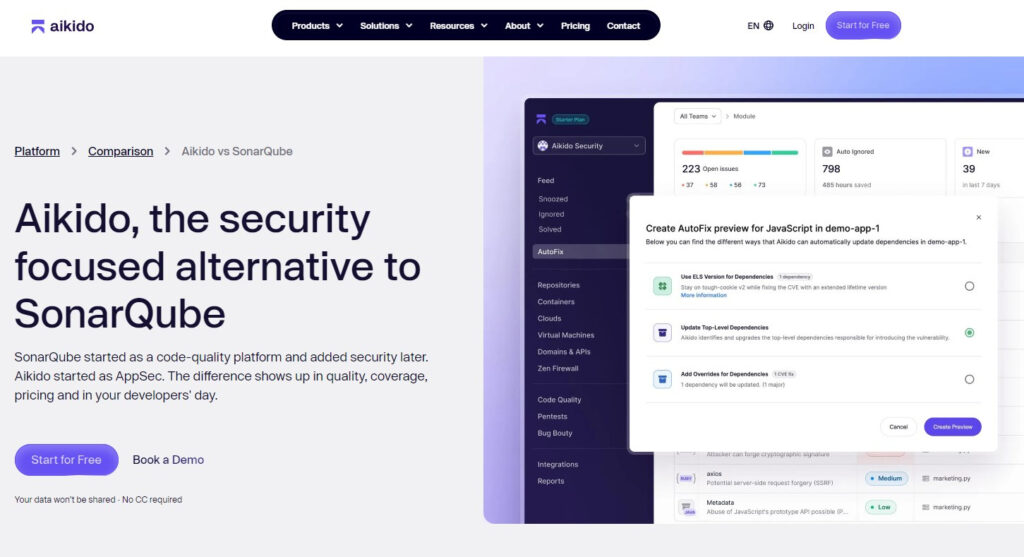
SAST, SCA, DAST, secrets, containers, IaC, and cloud posture – all live under one roof. But here is where things get interesting. The platform runs reachability analysis on every finding. The system checks if a vulnerable function ever gets executed in the code. That function never runs? The alert never shows up. Simple as that.
Aikido’s approach to alert fatigue:
- Reachability analysis filters out CVEs in unused dependencies. Large libraries like TensorFlow produce far fewer alerts because Aikido knows which functions the application actually executes.
- AutoTriage uses AI to prioritize findings. The system correlates vulnerabilities with the environment context. A CVE in a production container with access to sensitive data gets a severity boost. The same vulnerability in a dev sandbox gets deprioritized.
- Deduplication shows one CVE per repository instead of multiple alerts for the same issue. Traditional tools often generate duplicate warnings across different scanners or even within the same scan.
- Invalid CVEs and CVEs without fixes get temporarily ignored until a patch becomes available. Showing developers an issue they cannot fix serves no purpose.
Aikido charges per active developer. The company ditched per-line-of-code fees entirely. What you see is what you pay: no surprise add-ons for extra modules. The free forever tier includes two users. Paid plans start at €300 per month for 10 users.
As a SonarQube alternative firm, Aikido focuses entirely on security rather than code quality. SonarQube’s library is roughly 85% code quality and 15% security. Aikido reversed that ratio.
Who this fits: Engineering teams tired of chasing false positives. Organizations looking for developer-friendly SonarQube alternatives that reduce alert volume.
2. Snyk
Snyk cut its teeth on SCA. Open-source dependency scanning was the entry point. The company grew from there into a full developer security platform. Today, over 2,500 enterprise customers use Snyk. Developers lean on it for code scanning, dependency checks, container security, and infrastructure as code.
The platform plugs straight into IDEs. Git repos get connected. CI/CD pipelines integrate without fuss. Snyk AppRisk handles the heavy lifting on prioritization. The system figures out which vulnerabilities actually threaten the application.
AI connects the dots between SAST and DAST findings. Only reachable risks surface. The rest fade away. Less noise means faster fixes. Teams spend less time triaging and more time shipping.
Snyk’s approach to alert fatigue:
- Reachability analysis filters out vulnerabilities in dependencies that are never called.
- AI-driven SAST-to-DAST correlation connects findings across different testing phases.
- Risk-based scoring prioritizes findings based on exploitability and production exposure.
Snyk claims a 0.08% false positive rate for its API and web testing. The platform scans for over 3,000 vulnerability types, including XSS and SQL injection. Findings appear directly in pull requests. Developers get actionable fix advice without leaving their workflow.
Pricing follows a per-developer model. Free tier available for individual users. Team plans start at $25 per user per month. Enterprise pricing requires a sales call.
Who this fits: Teams seeking SonarQube alternatives have low noise through AI-driven correlation. Organizations already using Snyk for SCA looking to expand coverage.
3. Jit
Jit launched in 2021 with a simple mission. Make security easy for developers to adopt. In May 2026, Torq acquired Jit to build next-generation autonomous security operations. Jit had already deployed thousands of AI security agents into production across nearly 100 enterprise customers before the acquisition.
The platform creates an AI context graph. This graph maps relationships across code, identities, permissions, data sensitivity, and runtime behavior. Instead of isolated alerts, Jit uses context to assess risk.
Jit’s approach to alert fatigue:
- Workflows automate vulnerability triage. Teams define conditions for alerting. For example, only trigger Jira tickets for critical vulnerabilities in internet-facing production services. The system handles the rest automatically.
- Priority factors boost scores based on context. A finding in production gets a 20-point boost. Internet-facing services get additional points. These factors help teams focus on the most dangerous risks.
- Conditional triage routes issues only to the relevant team. Developers see only findings for their services. They do not get flooded with alerts for unrelated applications.
Jit unified 40+ security scanner integrations into one interface. Teams enable scanning with one click after connecting their source code manager and cloud environment. The platform never clones customer code to its cloud, reducing compliance concerns for regulated industries.
Pricing requires contacting sales. The platform positions itself for enterprise buyers.
Who this fits: Security-conscious teams with strict data residency requirements. Organizations that want automated triage workflows to reduce manual effort.
4. Opengrep
Opengrep is an open-source static analysis tool focused on code security. The platform scans for vulnerable patterns using rules that look like the code itself. Developers call it “semantic grep” because it works like grep but understands code semantics.
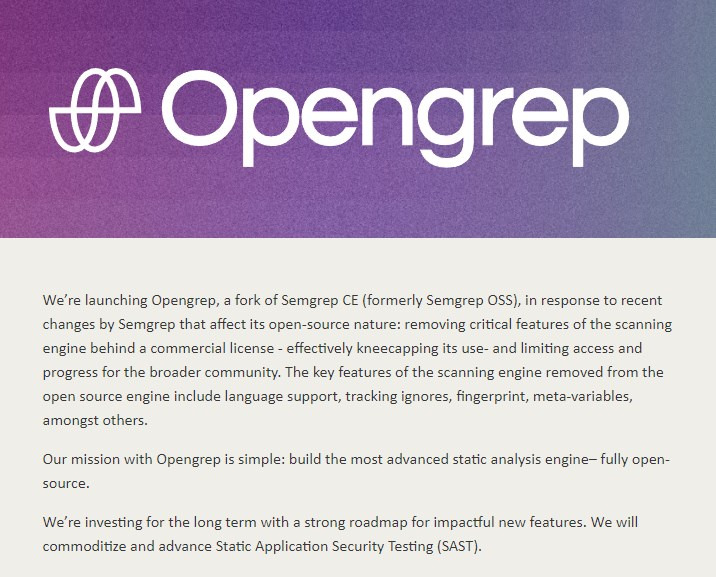
The free and open-core tool gives teams production-grade SAST without licensing costs. The community rule set covers OWASP Top 10, CWE, and common vulnerability patterns.
Opengrep’s approach to alert fatigue:
- Rule-based scanning catches known vulnerability patterns. The fast pattern-matching engine analyzes code at 20,000 to 100,000 lines per second.
- Custom rules allow teams to write their own detections. The rule syntax looks like the source code being analyzed. Writing a custom rule takes minutes instead of days.
- Integration with CI/CD surfaces findings in pull requests. Developers see issues in context.
The free tier includes unlimited repository scanning. The core engine runs on GitHub Actions, GitLab CI, and other platforms. Enterprise features like cross-file analysis, central management, and team collaboration require a paid plan.
However, Opengrep’s extensive rule library can produce high alert volumes out of the box. Not all findings are exploitable issues. Teams often need to tune rules to improve the signal-to-noise ratio.
Who this fits: Open-source projects and budget-conscious teams. Organizations that want to write custom rules for their specific security requirements.
5. Prisma Cloud (Palo Alto Networks)
Prisma Cloud is Palo Alto Networks’ cloud-native security platform. The company has a long history in enterprise security. Prisma Cloud serves over 2,000 enterprise customers worldwide.
The platform protects the software supply chain from the first line of code to the running application. It scans source code, open-source dependencies, IaC templates, container images, and CI/CD pipelines. Security checks run at each step.
Prisma Cloud’s approach to alert fatigue:
- Unit 42 threat intelligence powers runtime threat detection. The threat research team sends attack data from the wild straight into Prisma’s detection engine.
- Kubernetes-native posture management uses an admission controller to block insecure images before they reach production.
- Agentless scanning reduces operational overhead. No agents to install on cloud resources.
Prisma Cloud recently added five new CSPM capabilities. End-to-end network path visibility eliminates alerts for unexposed cloud instances and security groups. Visibility-as-code lets Prisma support new cloud provider services within days instead of months.
Machine learning detects abnormal egress traffic to TOR exit nodes and anomaly compute provisioning. These capabilities catch data exfiltration and potential cryptojacking.
Prisma Cloud pricing follows a credit-based consumption model. Customers purchase licenses through Palo Alto Networks, channel partners, or cloud marketplaces. Credits are consumed based on the modules and resources being protected. Licensing is available as one-, two-, or three-year subscriptions.
Who this fits: Large enterprises already using Palo Alto products. Teams needing deep Kubernetes runtime protection and advanced cloud threat detection.
6. Qualys
Qualys is a well-established player in the vulnerability management space. The company has been around for over two decades. Qualys serves over 10,000 customers worldwide, including the Fortune 500.
The Qualys Cloud Platform covers vulnerability management, container security, web application scanning, and cloud posture management. The platform scans for vulnerabilities across the entire IT infrastructure, including on-premises and cloud environments.
Qualys’ approach to alert fatigue:
- Vulnerability prioritization uses threat intelligence to score risks. The platform considers exploitability, malware kits, and active attacks in the wild.
- Asset inventory tracks all resources. Teams know exactly what they need to protect.
- Continuous monitoring scans for new vulnerabilities as they emerge. No need to schedule periodic scans.
Qualys Container Security scans container images for vulnerabilities. The platform integrates with CI/CD pipelines and container registries. Findings include remediation guidance and vendor-supplied patches.
Web application scanning covers OWASP Top 10 vulnerabilities. DAST runs continuously or on demand. The platform uses authenticated scanning to find issues that unauthenticated scanners miss.
Pricing is custom. Qualys positions itself for enterprise buyers. The platform is complex and often requires dedicated personnel to manage effectively.
Who this fits: Large organizations needing broad vulnerability coverage. Teams with dedicated security personnel who can manage complex platforms.
Additional Insights on Alert Fatigue
Alert fatigue occurs when security tools generate too many low-value alerts. Developers become desensitized. They start ignoring notifications. Critical vulnerabilities get overlooked.
The problem is widespread. Recent research shows that 70% of a security team’s time is spent investigating false positives. Thirty-three percent of companies have been late responding to actual attacks because their teams were busy with phantom threats.
The most effective noise reduction strategies include:
- Reachability analysis checks whether a vulnerable function actually gets called. If the code never executes the vulnerable path, the alert does not appear. This eliminates up to 85% of noise in some platforms.
- Contextual prioritization scores vulnerabilities based on the environment. A CVE in production with sensitive data access gets higher priority than the same CVE in a dev sandbox.
- Automated triage routes findings to the right teams automatically. Developers see only issues with their services. Security teams focus on critical risks.
- Deduplication combines multiple alerts for the same issue into one notification. Traditional tools often generate duplicates across scanners or even within the same scan.
- Actionable remediation guidance provides clear steps to fix issues. Developers can resolve findings without searching for solutions elsewhere.
The platforms above implement these strategies differently. Some focus on reachability. Others use AI-driven correlation. A few prioritize automated workflows. The best choice depends on team size, infrastructure complexity, and security requirements.
Final Thoughts
Aikido applies reachability analysis across the entire platform. The system filters out unreachable CVEs, deduplicates findings, and temporarily hides issues without available fixes. The result is an 85-95% reduction in false positives according to G2 reviewers.
One flat price covers SAST, SCA, DAST, secrets detection, container scanning, IaC scanning, and cloud posture management. Per-seat fees never appear on the invoice. Module upcharges are not something teams need to worry about. Teams see actionable findings without the noise that forces developers to ignore the tool.
Snyk offers AI-driven correlation between SAST and DAST findings. Jit automates triage workflows with contextual priority factors. Opengrep provides fast, rule-based scanning with custom rule support. Prisma Cloud brings Unit 42 threat intelligence to runtime protection. Qualys covers the entire infrastructure with vulnerability prioritization.
Among all-in-one SonarQube alternatives to consider, Aikido stands out for noise reduction. The platform was built specifically to solve alert fatigue, not as an add-on feature. Snyk offers strong AI-driven correlation for reachable risks. Jit automates triage workflows to keep teams focused.
When looking for SonarQube alternatives for cloud and container security, Prisma Cloud delivers enterprise-grade protection. Qualys provides broad vulnerability management across the entire stack. Opengrep serves as a solid option when looking for SonarQube alternatives for containers and cloud posture management.
The best choice depends on team size and security requirements. But for reducing alert fatigue, Aikido’s noise reduction approach removes irrelevant alerts and CVEs from the developer’s view. This allows genuine threats to get more attention. Fixes get applied faster. Developers stay productive. Security improves.